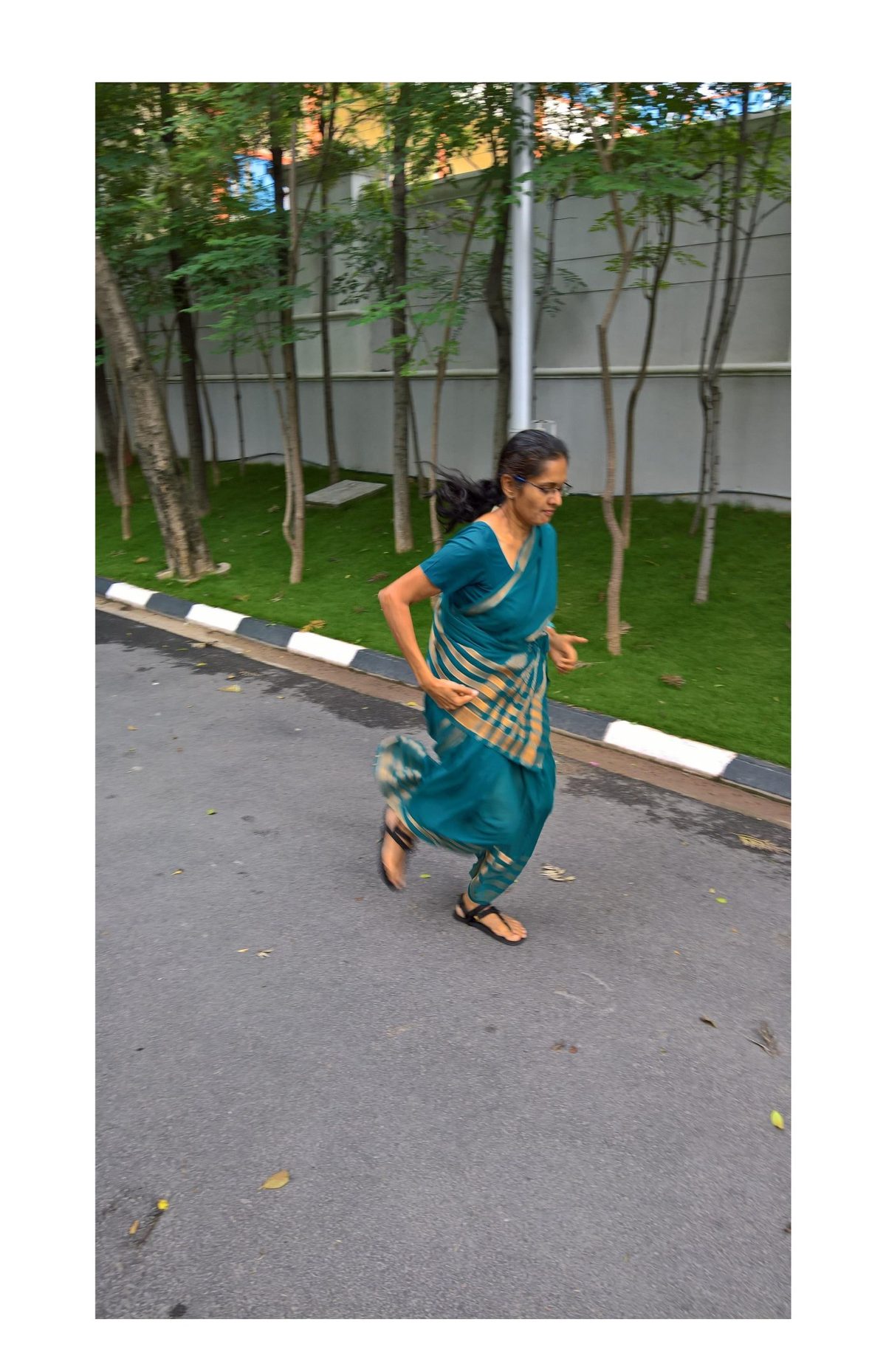
What sari to wear?
Around the time I was experimenting running barefoot or with sandals, I also did my first run in a sari. At that time, I was not sure that I would be able to run AHM in a sari. Hence I only did solo training runs in the sari (or runs with my husband) where I would not have to explain to other fellow cyclists or runners why I was running in a sari :).
My family was super supportive of my effort. My mother was the biggest supporter of my running in a sari. We discussed about what style of sari would work and she suggested that 9 yards would be the best. I agreed with it since the 6 yard sari is typically worn with a peticoat and that would definitely hinder the running.
It was hard to get a 9 yard sari (cotton one) in the stores in Hyderabad. My friend Sravanthi who runs a beautiful Boutique called Handpicked, also looked for options. She got me a 9 meter cloth in mull cotton and other variations to try out as well. But I wanted a sari since the material seemed heavier than what a sari would be.
At this time my parents were making a trip to Chennai and bought a nine yard sari for me from Chennai. The sari was light and looked nice. I did quite a few training runs in it. It worked well, but I was worried that jari in the sari would cause chaffing during the long runs.
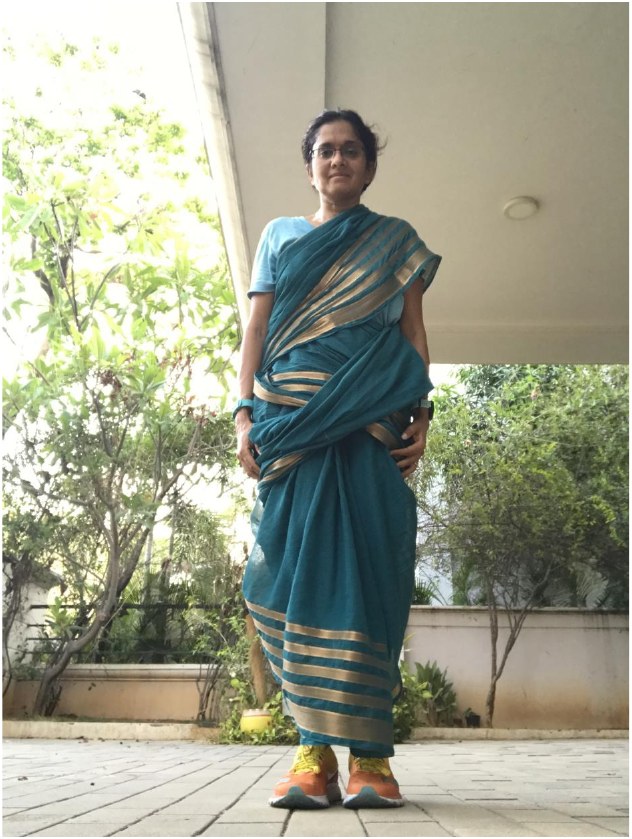
Then I remembered that not so long ago, I had got a very light IKAT handloom six yard sari from Sudha Rani. I had gifted that sari to my mother-in-law and she really appreciated how light and beautiful it was. Hence I decided that this would be the right kind of sari for my run. I asked Sudha to work with the handloom weavers to make a nine yard sari just like the 6 yard one for me. It had to be special ordered since normally the weavers only weaved 6 yard saris. Sudha said that it would take time, I understood that and waited for it patiently. The first sari that came was brown and black in color. It was light and perfect for training but for the actual run I wanted a brighter color. I waited for few more weeks to get 3 beautiful saris in bright blue, red and purple colours. The saris were totally worth the wait.
I loved handloom saris and was excited that I was going to be running in a handloom sari specially weaved for me by the weavers. My passion for running, my love for sarees and the desire to encourage handlooms and the weavers were all nicely coming together. Sudha was also very happy that I was going to run in a sari specially created for me by the IKAT weavers whom she works with. This encouraged me further.
How to wear the sari
The traditional way of wearing a 9 yards sari (like my grandmother used to) could have worked. I remembered it but not so well. Then this video really helped me recollect the style. However, I had my doubts about whether it would work. A practice run wearing the sari in the madisar style had the sari flying off to the sides when faced with headwind or tailwind. It was quite embarrassing.
Then I experimented with different styles including the Nauvari style. I even experimented with a 6 yard sari tied in the Nauvari or the Madisar style. But the sari length was short and the style of tying needed the nine yards. My coach Vignan was very encouraging and sent me many links and videos on how to wear a sari :). The Nauvari style seems to work and I did a test run in it too. But it was not good on a longer run and I was always worried about the tucked in part in the back or front sliding out. Through all these experiments I tripped and fell a few times. Every fall would reset my training by couple of days at least. But I could not give up.
There were days I used to be awake in the nights thinking of the sari length, the number of pleats on the left, the number of pleats on the right, how much sari to pull through, how much sari length to leave for the second loop. The fact that I was growing thinner with all the exercising kind of helped :).
Finally I settled on a modified Madisar style with two secure knots to hold the sari in place at the hip and additional safety pins to hold the sari in place on the legs. I folded up the second layer so that it did not hinder my movement. Even though I could run well with this, headwinds or tailwinds were a problem. The sari would push on my legs and I realized that I was spending more energy on the run than I would have done without the sari. But that just meant that I had to train more.
To illustrate how I wore the sari I am planning to make a video showing the details of it and publish it soon.
Coincidence?
After getting the saris and while training with them, I found that these were the same weavers Microsoft was supporting through the CSR initiative called ReWeave. Sudha Rani was the project manager for that project. This created an even closer connection for me with these handloom saris. I wore one of the nine yard saris to work on National Handloom day, feeling very happy about supporting the handloom weavers.